Does eating late cause weight gain? What chrononutrition can tell us
Meal timing deserves a place in planning. Understand what a study using data from 7,379 people found, where its limits lie, and how to decide when training takes place at night.

Imagine two meals at 10 p.m. One ends the day for someone who spent the afternoon snacking and continues eating in front of the television. The other supports recovery for someone who has just finished a demanding training session. The time is the same. To plan food intake, we still need to understand the rest of the day.
Chrononutrition investigates how the timing of food intake relates to biological rhythms and health. It is a relevant dimension of nutrition, especially when daily routines push much of food intake late into the evening. Problems arise when a research finding becomes a rigid rule: dinner after a certain time causes weight gain, skipping a meal solves it, or a shorter eating window is always better.
A study published in Clinical Nutrition helps clarify this discussion. Its findings justify examining meal timing. Its design calls for caution before turning them into a prescription.
What NHANES showed
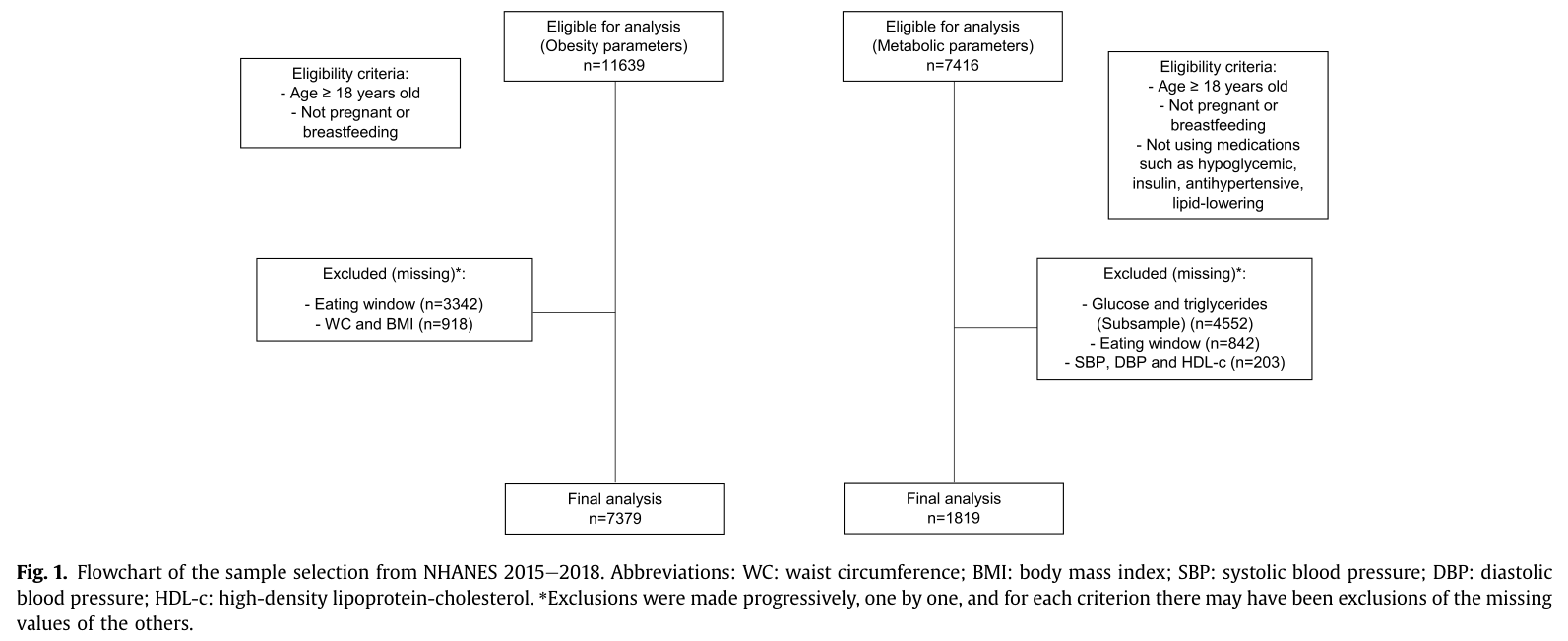
Bernardes da Cunha and colleagues analyzed NHANES data from 2015 to 2018, a survey of health and nutrition in the US population. The study was cross-sectional: meal timing and health conditions were assessed within that survey, without following whether changing meal times altered metabolism over subsequent years.
The obesity analyses included 7,379 people: 4,879 in the adult group and 2,500 in the older adult group. For metabolic parameters, the sample comprised 1,819 participants. That analysis excluded users of certain medications and depended on the availability of laboratory tests and other information.
Timing came from two 24-hour dietary recalls on nonconsecutive days. The researchers assessed the interval between the first and last intake, the times of those two occasions, the midpoint of that interval and the number of eating episodes. Food or drink intake providing at least 1 kcal could count as an episode, so the window included more than main meals.
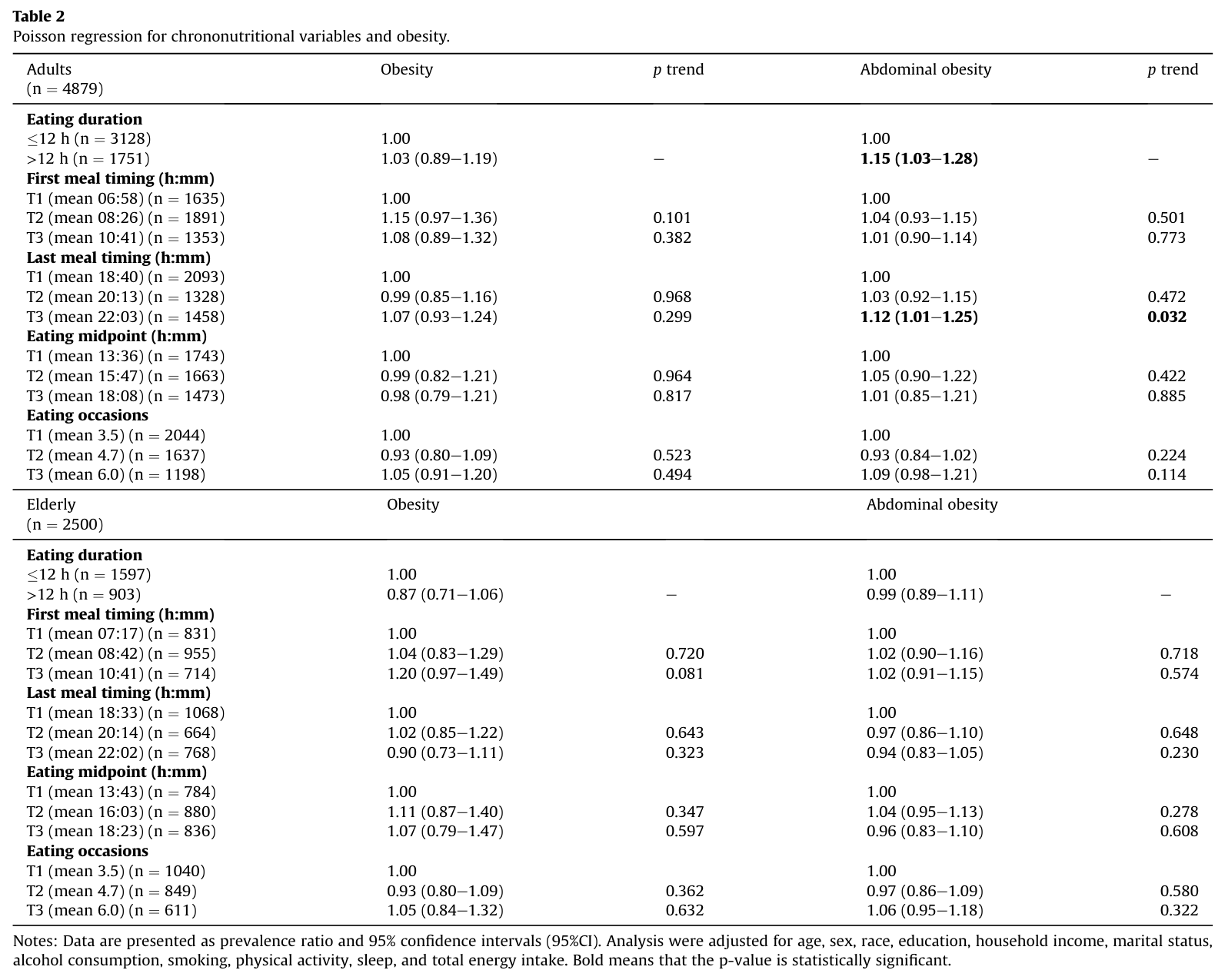
After adjustment for variables such as age, sex, income, physical activity, sleep and energy intake, adults with an eating window longer than 12 hours had a higher prevalence of abdominal obesity: a prevalence ratio of 1.15, with a 95% confidence interval of 1.03 to 1.28. In the group with the latest final meal, the ratio was 1.12, with an interval of 1.01 to 1.25, compared with the earliest group.
These are relative differences in prevalence of 15% and 12%. They do not mean gaining 15% more fat or adding 12 percentage points of risk. Nor does the study tell us how much someone’s waist circumference would decrease if they moved dinner earlier. [1]
Abdominal obesity in adults
NHANES 2015–2018 · n = 4,879 · adjusted prevalence ratios
Vertical line at 1.00 = no relative difference in prevalence.
There are positive associationsThe first two intervals are above 1.00, with estimates close to that reference.
The pattern is not uniformThe interval for the intermediate comparison includes 1.00. It does not demonstrate a statistically significant difference.
The design limits applicationThe cross-sectional data do not tell us how much waist circumference would change if dinner were moved earlier.
View the same data in a table
The size of the signal, in context
Study data faithfully reformatted · adults · Table 2 · NHANES 2015–2018
| Comparison | Prevalence ratio | 95% CI |
|---|---|---|
| Window >12 h versus ≤12 h | 1.15 | 1.03–1.28 |
| Last meal: T3 versus T1 Means: 10:03 p.m. versus 6:40 p.m. | 1.12 | 1.01–1.25 |
| Last meal: T2 versus T1 Means: 8:13 p.m. versus 6:40 p.m. | 1.03 | 0.92–1.15 |
1.00 indicates no relative difference. The interval for the intermediate comparison includes 1.00. Times are group means, not safety thresholds. Adjustments: age, sex, race, education, income, marital status, alcohol, smoking, physical activity, sleep and total energy intake.
A later eating midpoint was also associated with elevated fasting glucose in adults. Among older adults, a window longer than 12 hours was associated with elevated triglycerides, with a less precise estimate. In contrast, the tables did not show consistent statistically significant associations with BMI-defined obesity or metabolic syndrome overall. Interpretation needs to preserve both the positive and the nonsignificant findings. [1]
Why the biological clock belongs in this discussion
Our bodies follow rhythms of approximately 24 hours. Light, sleep, wakefulness and food intake help organize this functioning. The metabolic response to a meal may vary with its biological timing, providing a plausible rationale for investigating the benefits of shifting intake earlier.
However, clock time describes only part of the exposure. A meal at 9 p.m. may fall at different points relative to sleep for two people. Shift work, chronotype and training routines also change the context. The NHANES study did not measure individual circadian phase or experimentally isolate these factors. The mechanism helps frame the hypothesis, but it does not demonstrate that a particular late meal will cause fat gain.
What the trials add
In a trial involving 139 people with obesity, Liu and colleagues compared calorie restriction with and without an eating window from 8 a.m. to 4 p.m. over 12 months. The between-group difference in weight was −1.8 kg, with a confidence interval of −4.0 to 0.4 kg. Because this interval includes no difference, the study did not demonstrate a statistically significant additional benefit of the eating window for the primary outcome. This does not establish absolute equivalence between the strategies either. [2]
A network meta-analysis published in 2026 brought together 41 trials and 2,287 participants. It found advantages of early over late eating windows for some measures, including a mean weight difference of −1.15 kg. Results for the ideal window duration were less consistent. The synthesis combined direct and indirect comparisons, and its search ended in January 2023; the publication date does not mean that all recent trials were included. [3]
Another 2026 network meta-analysis, with searches through April 2025, found limited differences between several eating-window patterns and calorie restriction, although rankings favored earlier strategies. It excluded professional athletes, highly active populations and shift workers, limiting its applicability to those routines. [4]
Taken together, the evidence gives us reasons to consider timing as part of the strategy. It still requires attention to the population, the comparator, total dietary intake and the ability to maintain the routine.
Where interpretation can go too far
The first limitation is the direction of the relationship. People with metabolic abnormalities may change their eating habits; other features of their routine may affect both timing and health. Statistical adjustments reduce part of this problem, but they do not eliminate residual confounding or establish causality.
The second is how food intake was measured. Two days of recall provide useful information, but they do not perfectly describe weeks of routine. Underreporting, day-to-day variation and differences in sleep patterns may affect classification. Many associations were also tested, without a reported correction for multiple comparisons. Findings close to the significance threshold require particular caution.
The third is turning an analytical category into a clinical target. The division between up to 12 hours and more than 12 hours does not establish a biological point where risk changes abruptly. Similarly, 10:03 p.m. was a group mean: the study did not identify a universal time after which eating becomes harmful.
Nighttime training adds another layer to the decision
Finishing food intake early may conflict with an evening training session and recovery needs. The NHANES findings do not establish that removing the meal after that session improves athletes’ health.
Training has ended.
Recovery is still part of the plan.
A late meal may serve a planned purpose. The day’s food intake, demands and proximity to sleep all belong in the assessment.
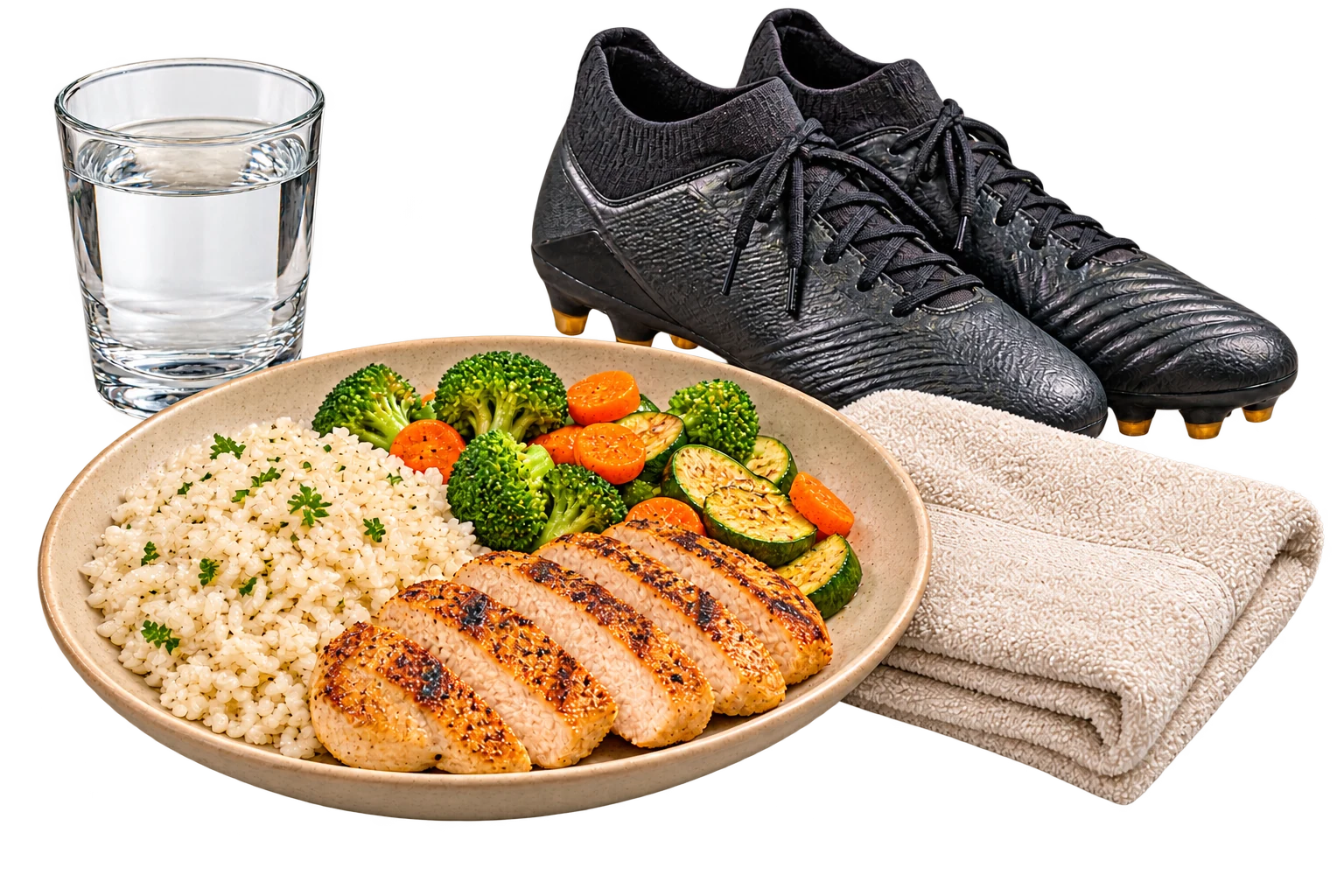
In sports nutrition, the amount, composition and distribution of intake need to match training and competition demands. Carbohydrates and protein play roles in recovery, and planning depends on the workload, previous food intake and the interval until the next session. Sports nutrition recommendations support this principle; its application here is a contextual decision, not an outcome tested in NHANES. [5]
For a session that ends late, one option is to better organize earlier meals and plan recovery intake that matches the demands and digestive tolerance. Composition and volume can be adjusted when bedtime follows shortly afterward. The decision needs to preserve adequate intake and consider sleep, hunger, discomfort and next-day performance.
The meal’s purpose guides the assessment
from nighttime training?
Plan recovery
Preserve the meal’s purpose. Consider the demands, previous intake and tolerance.
Review evening eating patterns
Explore hunger, the distribution of intake throughout the day and unplanned eating.
routines and individual circumstances.
How to include chrononutrition in your plan
Start by recording your actual routine for several days, including training days, rest days and weekends. Note the first and last intake containing calories, sleep and training times, hunger throughout the day, and what usually happens after dinner. This record helps organize the decision; it is not a diagnostic test.
If evenings involve improvised meals and repeated unplanned eating, assess how intake is distributed throughout the day. When feasible, moving some intake earlier and organizing the end of the day may be a practical experiment. An aggressive eating window is not necessary to start addressing a disorganized routine.
If the last meal supports recovery from nighttime training, preserve that function in the plan. Look for adjustments to distribution, composition and logistics before simply removing it. People taking medication that affects blood glucose or with specific clinical needs require an individual assessment before restricting eating times; that population was not fully represented in the study’s metabolic analysis.
Monitor whether the change is sustainable and what happens to hunger, sleep, digestive symptoms and training. When there is a clinical goal, measurements and laboratory results should be interpreted during follow-up. An earlier dinner cannot automatically take credit for improvements that occur alongside changes in energy intake, dietary quality and physical activity.
Timing deserves to be assessed. The decision improves when it connects that timing with the day’s food intake, sleep, training and the goals of the person following the plan.
Is your dinner the result of an improvised routine, or a meal planned around the day’s demands? That is a useful question to bring to your next nutrition assessment.
References
- Bernardes da Cunha N, Teixeira GP, Madalena Rinaldi AE, Azeredo CM, Crispim CA. Late meal intake is associated with abdominal obesity and metabolic disorders related to metabolic syndrome: A chrononutrition approach using data from NHANES 2015–2018. Clinical Nutrition. 2023;42:1798–1805. DOI: 10.1016/j.clnu.2023.08.005. PMID: 37586316.
- Liu D et al. Calorie Restriction with or without Time-Restricted Eating in Weight Loss. New England Journal of Medicine. 2022;386:1495–1504. DOI: 10.1056/NEJMoa2114833. PMID: 35443107.
- Chen YE, Tsai HL, Tu YK, Chen LW. Effects of timing and eating duration of time restricted eating on metabolic outcomes: systematic review and network meta-analysis. BMJ Medicine. 2026;5:e001071. DOI: 10.1136/bmjmed-2024-001071.
- Hamsho M et al. Early, midday, and late time-restricted eating impact on anthropometry and cardiometabolic health: a network meta-analysis of RCTs. Frontiers in Nutrition. 2026;13:1887087. DOI: 10.3389/fnut.2026.1887087.
- Thomas DT, Erdman KA, Burke LM. Position of the Academy of Nutrition and Dietetics, Dietitians of Canada, and the American College of Sports Medicine: Nutrition and Athletic Performance. Journal of the Academy of Nutrition and Dietetics. 2016;116:501–528. DOI: 10.1016/j.jand.2015.12.006. PMID: 26920240.