

When pain and fatigue already take up part of the day, adding exercise can feel like another demand. For someone living with an autoimmune disease, the decision needs to consider what the body can do now, which structures are affected and how to build a routine that can be maintained.
Movement can form part of that care. The expected benefit, however, needs a name: climbing stairs with less difficulty, regaining strength, walking more safely or managing particular symptoms better. The phrase “boosting immunity” is too broad to guide these decisions.
In autoimmunity, the immune response can target the body’s own tissues. Focusing only on strengthening that response oversimplifies a system that depends on regulation. The useful question becomes: which exercise, at what dose, for which person and at which clinical stage?
The benefit needs to be specific
In the review by Sharif and colleagues, published in 2018, exercise is associated with benefits across different dimensions of care. The paper brings together studies on rheumatoid arthritis, multiple sclerosis, lupus and other conditions, alongside research on immune mechanisms. Its central contribution is to show that a diagnosis, by itself, should not close the discussion about movement. Sharif et al., 2018
There are, however, three different questions within this body of work: do more active people develop certain diseases less often? Does an exercise program improve the lives of people already diagnosed? And do those changes result from a direct effect on autoimmunity? Each question requires its own research design and interpretation.
A person may gain strength without a meaningful change in a disease activity index. Aerobic capacity may improve without the study having demonstrated fewer cardiovascular events. Those gains are valuable, but they need to be communicated in terms of what they actually represent.
The benefit needs
to show up in daily life.
Choose a capacity that matters to the person. Then define how to assess the response.
Which task has become more manageable?
How is the ability to walk?
What limits the activity?

Muscle takes part in communication with the immune system
Contracting muscle produces signals involved in communication between tissues. These include myokines, molecules released by muscle. The review highlights interleukin 6, or IL-6, and its relationships with pathways involved in regulating inflammation. Sharif et al., 2018
The name of a molecule alone does not describe its entire function. Its source, the duration of the stimulus and the biological context matter. A transient rise associated with muscle contraction should not automatically be equated with persistent exposure during an inflammatory process.
This explanation provides biological plausibility for some effects of exercise. Demonstrating a clinical benefit still requires observing people: how they feel, what they can do, whether the disease remains controlled and which problems arise. A laboratory change does not replace those answers.
From muscle to signal.
From signal to clinical question.
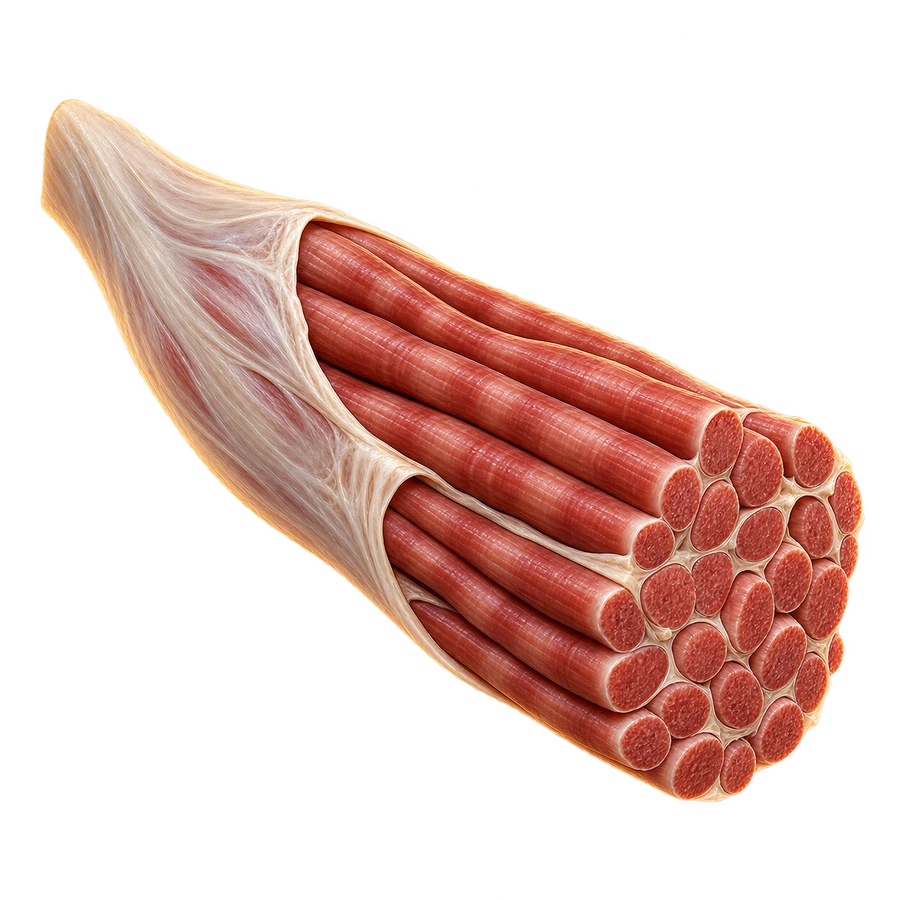 Schematic representation
Muscle contraction
Muscle takes part in communication between tissues.
Myokines
Signals such as IL-6 have functions that depend on their source, duration and context.
Biological response
A plausible mechanism helps explain a hypothesis.
Measure outcomes in people: function, symptoms and disease activity. A change in a marker does not replace these outcomes.
Rheumatoid arthritis, multiple sclerosis and lupus require distinct interpretations
Rheumatoid arthritis: maintaining capacity and independence
The American College of Rheumatology guideline, named for 2022 and published in 2023, strongly recommends regular participation in exercise. The program forms part of treatment alongside disease-modifying medications. Exercise mode and dose need to take account of capacity, preferences, joint loading and access to guidance. England et al., 2023 · 2022 ACR guideline
For the reader, this changes the conversation: instead of giving up all activity because of the diagnosis, it is useful to identify tolerable movements and the adaptations that make them possible. Strength training, aerobic activity and other modes can serve different purposes within that plan.
Multiple sclerosis: adapting is also training
The recommendations by Kalb and colleagues cover different levels of disability and emphasize specialist assessment, individual progression and adjustments when symptoms fluctuate. In people who are sensitive to heat, exercise may temporarily worsen symptoms; the environment and rest breaks deserve attention. Kalb et al., 2020
The goal of a program may include mobility, balance or the ability to carry out tasks. An adapted activity, including assistance when needed, should be assessed by the function it preserves and the feasibility of repeating it. Comparing it with a workout performed by someone without those limitations adds little to the decision.
Lupus: recommending movement requires acknowledging uncertainty
A 2023 Cochrane review included 13 studies with 540 participants. Compared with usual care, adding exercise may make little or no difference to fatigue, functional capacity and disease activity; certainty was low. Compared with other interventions, such as education or relaxation, there were signals of improvement in fatigue and function. Reporting of harms was insufficient. Frade et al., 2023 · Cochrane
These differences between comparators prevent us from promising everyone the same result. The 2026 British guideline, in turn, recommends encouraging physical activity according to lupus disease status, with tailored advice when needed. A clinical recommendation can consider the range of benefits and the context, even when the size of a specific effect remains uncertain. Md Yusof et al., 2026 · BSR
Three conditions.
Three points to consider.
Compare the same criteria for each condition.
| Condition | Focus of the evidence | What to adapt | Important limit |
|---|---|---|---|
| Rheumatoid arthritis | Regular exercise is part of care. | Capacity and joint loading. | It does not replace drug treatment. |
| Multiple sclerosis | Function and mobility guide the goals. | Disability, heat and rest breaks. | Activity needs to accommodate limitations. |
| Lupus | Activity adapted to clinical status. | Disease activity and organ involvement. | Several specific effects remain uncertain. |
More active people and prevention: be careful with the leap
Table 1 of the 2018 review brings together observational research on physical activity and disease incidence. Such studies help identify associations, but they do not randomly assign people to an active or sedentary life. This leaves room for differences in health, habits and living conditions to influence the findings. Sharif et al., 2018
An association.
Visible uncertainty.
95% CI: 0.43–0.96
Higher leisure-time activity was associated with lower rheumatoid arthritis incidence. The observational design allows residual confounding; it does not show that starting an exercise program prevents the disease.
View the comparison and measurement details
Higher category: more than 20 min/day of walking/cycling and more than 1 h/week of exercise, compared with less than 20 min/day and less than 1 h/week. The authors use RR for the rate ratio estimated with a multivariable-adjusted Cox model. The estimate is neither absolute risk nor a treatment effect in people with RA.
View the original Table 1 from the review
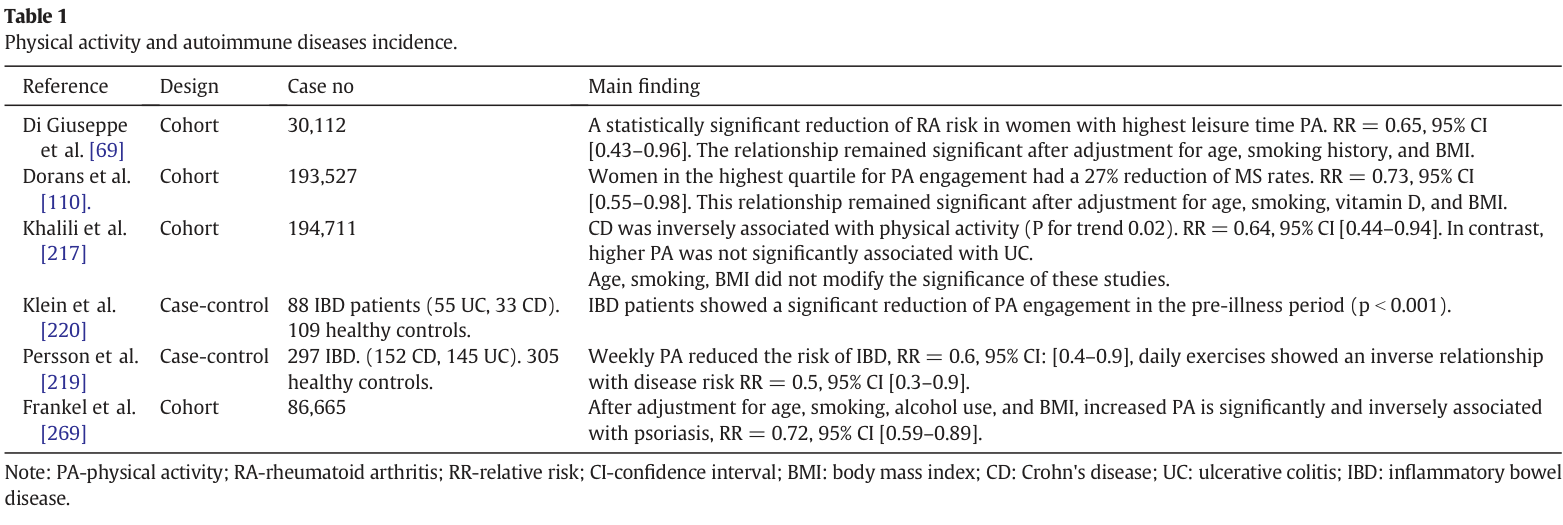
Reverse causation is also possible: symptoms preceding diagnosis may reduce the willingness or ability to move. In that case, some of the lower activity would already be a consequence of the disease process. Statistical adjustments help, but they do not eliminate all these explanations.
The practical decision can favor a more active life without attributing a guarantee of prevention to exercise. This distinction also avoids blaming someone for developing an autoimmune disease.
How to build a practical decision
The starting point is current disease status, combined with physical capacity and goals. A person who is stable and has received guidance to train can build a progression. Someone experiencing major changes in symptoms needs to reassess the plan before simply persisting with the same load.
In lupus, the 2024 international consensus recommends medical assessment before starting exercise and adaptation to abilities and comorbidities. During a flare, contraindications should be reassessed. Conditions such as myocarditis or pericarditis require specific evaluation, and inflamed joints need protection and adjustments to activity. Blaess et al., 2024
The next step
depends on the response.
in symptoms?
Reassess before progressing
Report the change to the team responsible for care.
Agree on an appropriate dose
Consider capacity, goals and the team’s guidance.
Record the response
Activity, duration, perceived effort and symptoms.
These steps organize the conversation with the responsible professionals; they do not form a universal prescription. As a practical example, consider someone who wants to walk more but feels exhausted by the proposed session. Reviewing duration, breaks and timing may make the activity feasible. Before attributing everything to deconditioning, the team also needs to consider the clinical context.
Nutrition and recovery belong in the same plan. The article reviewed does not test a diet, supplement or nutritional strategy capable of controlling autoimmunity. It therefore provides no basis for adding a nutritional promise to the exercise program. Difficulties with eating, recovery or maintaining a routine deserve individual assessment, without a standardized solution for every diagnosis.
The criterion is regaining possibilities
Exercise becomes meaningful when it expands what a person can do and fits into real life. This requires a relevant goal, an appropriate dose and a willingness to revise the plan when the disease or the response to training changes.
For someone living with autoimmunity, today’s best decision may be to progress, adapt or temporarily stop a particular activity. Quality of care lies in recognizing which of those decisions preserves the possibility of continuing tomorrow.