
A team needs a date. The athlete needs to be prepared for the actions they will face on returning. Between those needs, research numbers can help organize expectations. The problem begins when a group median is given the weight of individual clearance.
A 2026 study retrospectively assessed 42 professional football players with grade II hamstring injuries, involving the muscles at the back of the thigh. Median return time was 19 days. The range, from 11 to 54 days, already shows why turning that number into a deadline requires more care than it might seem. [1]
What the study actually called return
İnce and colleagues analyzed records of injuries occurring between 2016 and 2024, confirmed by magnetic resonance imaging. Players with complete clinical and return data were included. Eight years describes the period from which the injuries were collected; it does not mean eight years of follow-up for each athlete.
The outcome was the number of days from diagnosis to unrestricted full team training and/or match availability. The study did not measure actual match minutes, restoration of previous performance or the ability to sustain a sequence of matches. That definition needs to accompany any interpretation of the 19 days. [1]
The design at a glance
Retrospective cohort · MRI-confirmed grade II · 39 type 3A and 3 type 3B cases.
For people working in football, that distinction changes the discussion. Being available for selection, playing in a match and restoring performance answer different questions. The Bern consensus describes return as a continuum from participation through sport to performance. The aim of each stage needs to be stated before comparing athletes or studies. [2]
Participation
Partial or modified exposure, depending on the stage.
Sport
Return to the sport, potentially below the desired level.
Performance
Return to the intended performance level.
Grade II includes different recovery paths
All injuries were grade II under the conventional classification. Applying the Munich classification, the authors identified 39 type 3A cases and only three type 3B cases. This subdivision aimed to describe differences in structural involvement within the same broad category of partial injury.
In the 3A group, median return time was 18 days, with a range of 11 to 46. In the 3B group, it was 30 days, ranging from 25 to 54. The comparison yielded p = 0.026. This indicates an association between subtype and observed return time, but the 3B estimate rests on only three players. [1]
Same category. Different timelines.
Notice the overlap: some 3A returns took longer than some 3B returns. Imaging can contribute to prognosis and team communication; the label alone does not provide an individual timetable. The study also did not identify a day-based cutoff separating safe from unsafe return.
Three reinjuries call for proportionate interpretation
Three players sustained a new hamstring injury in the same leg within two months after return. The events occurred 27, 28 and 36 days later. All were in the 3A subgroup. The definition concerns the limb; the information presented does not establish that each event occurred at the exact anatomical site of the initial injury.
Players with reinjury had initially returned at a median of 14 days, compared with 20 days among the others. The ranges were 11 to 16 and 12 to 54 days, respectively. Again, p = 0.026. This compares groups defined by what happened afterward, without multivariable adjustment for other factors. [1]
There is a signal. There is uncertainty too.
3 of 42 players · 7.1% within two months
days · initial median for the 3 players with reinjury; range 11–16.
days · initial median for the 39 without reinjury; range 12–54.
This signal deserves investigation. It does not demonstrate that earlier return caused reinjury, or that waiting until day 20 would have prevented another problem. With three events, the analysis cannot robustly separate the roles of the injury, rehabilitation progression, subsequent exposure and decisions made in each setting.
What the analysis could not assess matters
Rehabilitation followed a general criteria-based framework, with progressive strengthening, running progression and football-specific tasks. It was not an identical day-by-day protocol across all clubs. Medical and performance teams individualized exercise selection and progression.
The analyzed records lacked objective strength measurements, GPS running metrics, individual training load, rehabilitation adherence and match exposure after return. The exact injured muscle, injury length and tendon involvement were not examined in detail either. These gaps limit explanations of why some players returned sooner or sustained another injury.
Age, BMI, injured side and playing position showed no statistically significant associations with return time in this sample. That does not establish that they are irrelevant in every setting. With few participants and only one injury grade, nonsignificant findings require the same caution as positive findings.
The cohort also selected complete records, and MRI examinations came from different centers and time points over the years. Confidence intervals for the main comparisons and correction for the multiple analyses were not reported. The direction of the findings is useful for generating hypotheses; their precision and independence remain limited. [1]
How to turn the study into a better decision
The first step is to define the destination: is the next stage a modified session, unrestricted team training or a match? Then information needs to be gathered that addresses those demands. Symptoms, strength, range of motion, running progression and football-specific actions should be interpreted alongside the athlete’s response to previous exposures. [3]
The next demand belongs in the assessment
Clinical assessment, strength, running and football tasks address different questions. No piece of equipment provides clearance on its own.
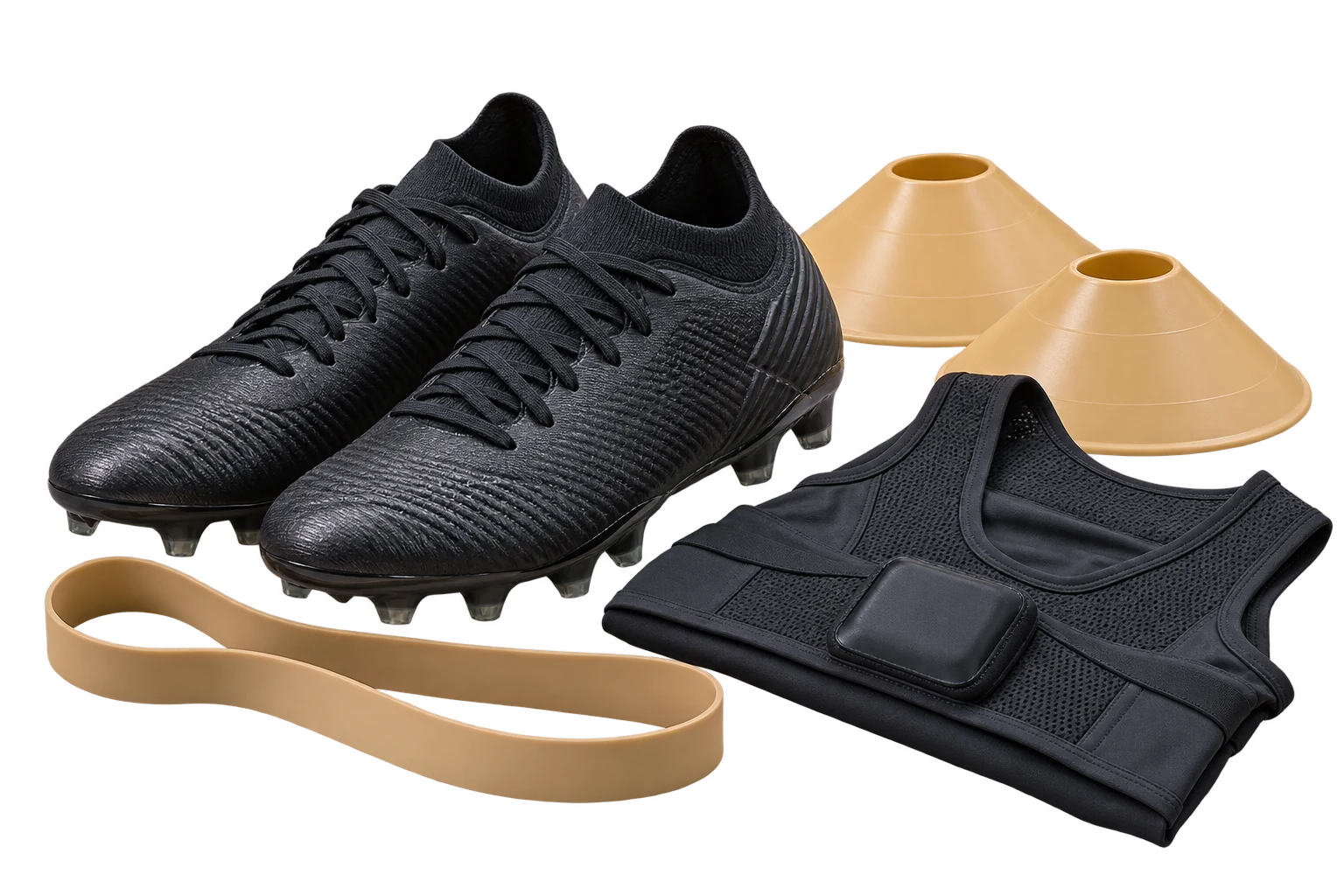
The study did not provide objective strength or GPS measurements. The illustration cannot reconstruct those data.
A scoping review published in 2025 organized return criteria into three groups: clinical, strength and performance criteria. This map shows why a test battery may need complementary information. It does not demonstrate that any combination of tests has been validated to eliminate reinjury risk. [4]
In 2026, a systematic review found frequent use of strength and pain-free criteria in decisions after hamstring injuries. It also highlighted range of motion and subjective readiness among criteria used more consistently in higher-quality intervention studies. Its search ended in March 2024, and the level of evidence varied across domains. [5]
This literature supports an integrated assessment without providing a universal clearance equation. The calendar remains necessary for planning; progression needs to reflect what the athlete can do, their tolerance of loading and the demands of the next stage. The player’s confidence and discussion among professionals also belong in that decision.
From a date to the next step
Complete the assessment
Gather the necessary information and adjust current exposure.
Discuss progression
Involve the athlete and team; individualize the next step.
Return continues after clearance
The three reinjuries were recorded weeks after return. This makes the subsequent period relevant to observe, but the study cannot prescribe a training load, number of matches or specific monitoring strategy. Those components depend on the history, injury, exposures and resources available to each team.
Athletes can bring concrete questions to their team: what activity am I returning to? Which capacities have been assessed? How will my response be followed after reintegration? The answers help turn a date into a shared plan, with understandable criteria and room to reassess progression.
The 19 days describe the center of a small sample. The individual decision needs to explain the player’s next step and remain under review when they return to the pitch.
References
- İnce AY, Afacan MY, Özyılmaz E, Korkmaz T. Return-to-Sport and Early Reinjury After Grade II Hamstring Injuries in Elite Professional Football Players. Acıbadem Üniversitesi Sağlık Bilimleri Dergisi. 2026;17. DOI: 10.31067/acusaglik.1942159.
- Ardern CL et al. 2016 Consensus statement on return to sport from the First World Congress in Sports Physical Therapy, Bern. British Journal of Sports Medicine. 2016;50:853–864. DOI: 10.1136/bjsports-2016-096278. PMID: 27226389.
- Paton BM et al. London International Consensus and Delphi study on hamstring injuries part 3: rehabilitation, running and return to sport. British Journal of Sports Medicine. 2023;57:278–291. DOI: 10.1136/bjsports-2021-105384. PMID: 36650032.
- Perna P, Kerin F, Greig N, Beato M. Return-to-play criteria following a hamstring injury in professional football: a scoping review. Research in Sports Medicine. 2025;33:175–194. DOI: 10.1080/15438627.2024.2439274. PMID: 39666593.
- Pecci J, van Dyk N, Myer GD, Sañudo B. Return-to-Play Criteria Following Lower Limb Muscle Injuries in Soccer: A Systematic Review with Evidence Synthesis. Sports Medicine. 2026;56:1433–1465. DOI: 10.1007/s40279-026-02404-9. PMID: 41851593.